A smart classroom isn’t defined by the number of screens in it. It’s defined by what those screens make possible. At Queen Mira International School (QMIS), technology isn’t bolted onto teaching — from Kindergarten to Grade 12, digital tools, simulations and AI-powered resources are built into how lessons are taught, learned and assessed. For parents evaluating a school’s infrastructure, that distinction — technology with a purpose, not technology for show — is one of the clearest trust signals to look for.
What Makes a Smart Classroom Actually Smart
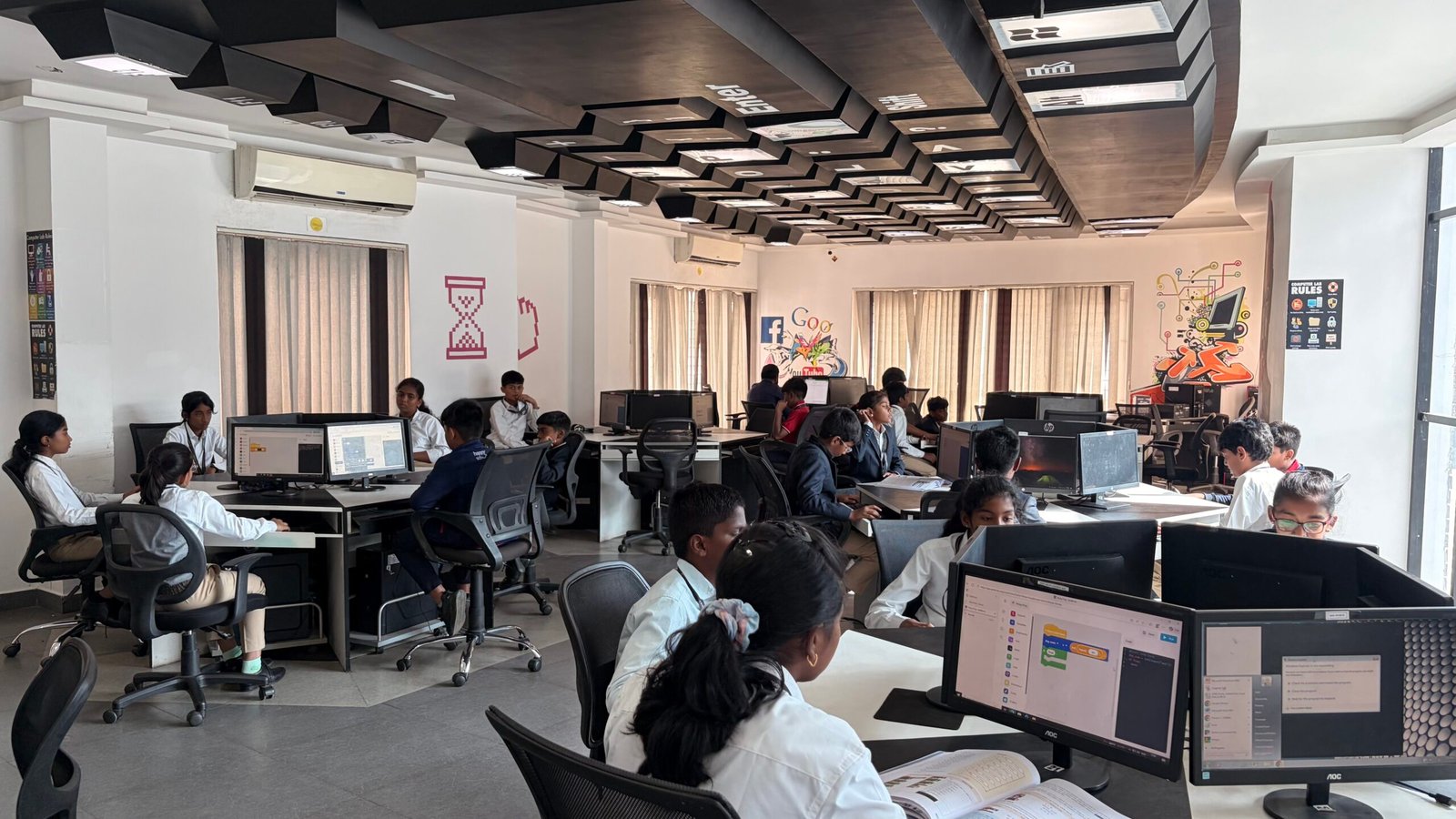
A scientific phenomenon can be simulated. A mathematical concept can become interactive. A chemical reaction can be explored virtually before it’s ever attempted in real life. At QMIS, this happens in dedicated spaces like the Thambaa Lab and Computing Lab, where students learn by experimenting, designing and problem-solving rather than only reading and listening. Trying an idea, seeing the result, and refining it teaches students that understanding doesn’t always arrive instantly. This kind of infrastructure — purpose-built, not just installed — is what separates a genuine smart classroom from a marketing claim.
CBSE Is Making EdTech Mandatory — QMIS Got There First
This isn’t just a QMIS initiative — it’s where CBSE itself is headed. From the 2026–27 academic session, CBSE has made Computational Thinking and AI mandatory for Classes 3 to 8, aligned with NEP 2020 and NCFSE 2023, focusing on digital literacy, ethical use of technology, logical reasoning and pattern recognition woven across subjects. QMIS’s Computing Lab and progressive AI education from the primary years mean the school was already building this foundation well ahead of the national mandate — a genuine marker of forward-looking EdTech leadership, not a reaction to it.
Teachers Stay in Control — AI Assists, It Doesn’t Replace
AI at QMIS supports teachers rather than replacing them. PhET simulations make abstract Science and Maths concepts interactive; GeoGebra supports mathematical visualisation; PubChem, ChemCollective and OLabs let students run virtual chemistry experiments; MagicSchool helps teachers plan lessons and differentiate instruction. AI can suggest and generate — but the teacher decides what’s right for each learner and how progress is assessed. That balance is exactly what parents should expect from any school claiming to be tech-forward.
Technology That Makes Assessment Meaningful
Digital tools at QMIS also strengthen assessment — interactive questions, application-based tasks and immediate feedback that reveal a student’s reasoning, not just their final answer. A student’s process, explanation or creation can offer insights a traditional question paper often misses. This connects directly with competency-based assessment, where technology is used to gather richer evidence of understanding rather than to digitise assessment for its own sake.
What Parents Should Look For
The right question isn’t “How much technology does the school use?” It’s “How does technology improve my child’s learning?” Parents can look for purpose-built labs rather than just digital boards, teachers who remain the instructional decision-makers, and assessment that captures how a child thinks, not only what they score. At QMIS, the answer is visible across every stage — in the Thambaa Lab, the Computing Lab, teacher-led AI integration across K–12, and a curriculum built to develop learners who use technology intelligently rather than merely comfortably.
Real Growth Beyond the Screen
A digital classroom is only the beginning. Real growth happens when technology becomes a tool for deeper thinking, meaningful learning and better possibilities — which is what makes QMIS‘s approach to smart classrooms and EdTech worth trusting, not just showcasing.