Why Concepts Get Stronger Every Year at QMIS
Have you ever wondered why a child learns a concept in one grade, revisits it the next year, and then meets it again at a deeper level later? This is spiral learning — an approach where important concepts aren’t taught once and left behind, but revisited, reinforced, and extended as students grow. At Queen Mira International School (QMIS), spiral learning helps students connect previous learning with new ideas, apply knowledge in unfamiliar situations, and build understanding that lasts.
What Is Spiral Learning?
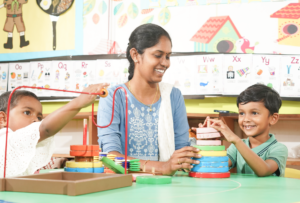
Picture a spiral : every time it comes around, it reaches a familiar point — but at a different level. A child may first meet a concept through a simple, concrete experience. In a later grade, the same concept returns with greater complexity, until students can analyse, apply and create using that knowledge. The concept stays familiar; the depth of understanding keeps increasing. This is very different from teaching a chapter, testing it, and moving on for good.
Why CBSE Has Made Spiral Learning Official
Spiral learning is no longer just good pedagogy — it’s now board policy. As part of the CBSE curriculum 2026–27, spiral learning has been introduced as a core methodology in Mathematics, revisiting key concepts at increasing complexity across grade levels instead of teaching a topic once and abandoning it. The reform is designed to improve concept retention, reduce learning gaps and build stronger problem-solving ability — exactly what QMIS’s own approach to concept building has long aimed for.
From Simple to Sophisticated
In Mathematics, a young learner may first meet patterns through simple numbers or shapes. As they progress, the same patterns become the foundation for algebraic thinking and problem-solving — genuine Maths concept building rather than isolated topic coverage. In Science, children begin by observing the world, then learn concepts, and eventually use them to investigate and explain phenomena. In Computing, students start with logical thinking and move toward computational thinking, programming and even Artificial Intelligence. The goal is never to repeat a lesson — it’s to revisit the idea with a new level of challenge.
Connecting Learning Across Years
QMIS’s curriculum philosophy keeps learning broad, balanced and blended, so students can connect ideas across subjects and years. A Maths skill can support scientific investigation. A Computing concept can support problem-solving. Communication strengthens project work. When students recognise these connections, knowledge stops being isolated facts and becomes something they can genuinely use.
What This Means for Parents
Seeing a familiar concept reappear in your child’s curriculum doesn’t mean nothing has changed. It usually means the concept now carries more complexity, new applications or more sophisticated thinking. That’s the strength of the spiral: your child returns to familiar ground with a more mature mind, building confidence even as understanding deepens.
Building Knowledge That Lasts
The purpose of spiral learning isn’t better short-term scores — it’s durable understanding. When students keep connecting new learning to what they already know, concepts get stronger, relationships get clearer and knowledge becomes easier to apply. At QMIS, and now under CBSE’s own 2026–27 reforms, the goal isn’t to teach children more each year — it’s to help them understand more deeply. Real learning isn’t about leaving yesterday’s knowledge behind. It’s about returning to it, extending it and using it to reach somewhere new.